From sales to marketing and customer service, artificial intelligence is reshaping how organizations use Salesforce. Salespeople turn to AI to spot the best opportunities, automated agents follow its recommendations, and marketers put it to work for a more tailored customer experience. As generative AI, Einstein and Agentforce take center stage in CRM strategy, organizations need AI readiness to support them and drive greater productivity and swifter decisions.
The underappreciated fact is that the quality of AI results is directly related to the data it accesses.
AI Is Changing the Game, but Clean Data Is Not Enough
It’s been standard practice for years to manage the health of Salesforce data. Organizations work to eliminate duplicates, fix errors, standardize formats and fill in missing pieces. And rightly so; Bad data can lead to bad business decisions.
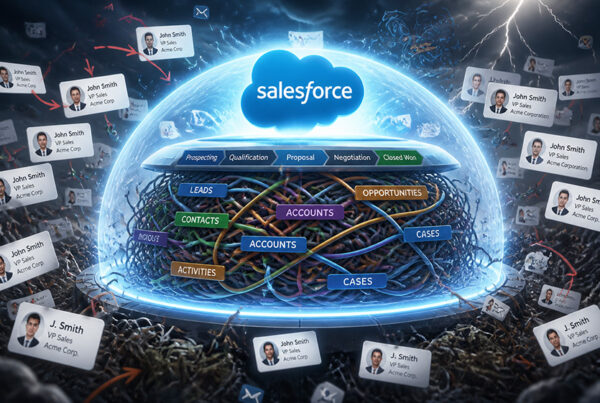
But modern AI requires more than traditional hygiene. AI isn’t simply reading the records stored in Salesforce—it is analyzing relationships, identifying patterns, generating recommendations, and answering business questions. A company may have moved its headquarters, brought on new leadership, or made an acquisition since its account record was last updated. The record can be perfectly formatted and still fail to reflect what is actually happening. Since business information is constantly changing, your data also needs to be updated over time. This broader definition of trusted data provides AI a dependable foundation for generating insights and recommendations.
What Makes Data Trustworthy?
Not all data deserves the same level of confidence. A CRM may contain millions of records, but volume, completeness, or even accuracy at a single point in time doesn’t guarantee the information can be trusted.
Trusted data is something else entirely. It is complete and well put together, but it has also been verified, cross-referenced with authoritative sources, and kept up to date. It follows governance standards that help ensure consistency across systems and provides confidence that business decisions are being made using accurate information.When a language model recommends the next best sales opportunity or flags an account for attention, it can confidently deliver the wrong information if the contact details or revenue figures are outdated.
Trusted data gives AI a more dependable basis for reasoning, recommendations, and action.
Why Public AI Knowledge Has Limits
Large language models are good at answering general questions, explaining concepts, and generating content because they have access to vast amounts of information that is publicly available. But publicly available knowledge has limitations when it comes to business intelligence.
Public information may include company websites, news articles, press releases, social media posts, public filings and other information published online. This information can provide valuable business context, but it is not necessarily structured, standardized or maintained as datasets for business intelligence. Descriptions of the same company may vary from source to source, as can the level of detail, reliability and timeliness.
This distinction is important for Salesforce AI. A public source might tell an AI model that a company exists, or that something happened to it. But applying business intelligence consistently across thousands or millions of Salesforce records requires more than finding individual pieces of information online. It requires structured data that can be reliably matched to the companies, people, and relationships in the CRM.
Why Commercial Data Providers Still Matter
Commercial data providers play an important role in modern CRM strategies because they do much more than simply collect information. They convert disparate signals from multiple sources into structured, usable business data and maintain that data as businesses change.
Company information can be found in countless places: websites, public filings, news mentions, business directories, professional profiles, technology signals, and more. Commercial data providers bring those signals together, resolve them to the right companies, people and relationships, and turn them into standardized entities and attributes that can be used consistently.
Instead of an AI system figuring out if multiple mentions of a company are about the same organization, a commercial dataset can provide a resolved company entity along with attributes like industry, headquarters, number of employees, revenue, technology usage, subsidiaries and key contacts. This gives Salesforce and AI systems structured business intelligence they can use consistently at scale.
For AI to be of real use, it needs the kind of accurate firmographic, technographic and financial details that only a trusted dataset can supply. That structured intelligence can support use cases ranging from lead qualification and account scoring to customer engagement and forecasting. In short, AI does not supplant the commercial provider; it can be more effective when it has access to the business data commercial providers maintain.
Why Organizations Need Multiple Trusted Data Sources
No single provider has complete coverage across every industry, geography, or type of data. Since different providers have different strengths, using multiple trusted sources can improve coverage, fill gaps, and provide a way to compare conflicting information.
Using multiple reputable providers allows organizations to build a more complete, rich and reliable view of their customers, for Salesforce and AI work with.
How DataGroomr Helps Orchestrate Trusted Data
Managing multiple data providers, however, creates a new challenge. Different providers may deliver conflicting information, create duplication, or leave different gaps. Organizations need a way to determine which data to use when, how to handle conflicting information, prevent unnecessary duplication and how each source contributes to the overall customer record. Manual review processes, inconsistent governance policies, and ongoing Salesforce synchronization can become cumbersome and messy.
DataGroomr addresses these challenges by serving as an orchestration layer across trusted data sources. It coordinates enrichment from preferred providers with verification, monitoring, and governance helping organizations manage how external data is managed as part of a unified data quality strategy.
By bringing these activities together, DataGroomr helps organizations fill data gaps, resolve inconsistencies, prevent duplicates, and maintain Salesforce records that remain accurate and trustworthy over time.
Key Takeaways
There is no denying that artificial intelligence has quickly become an important part of the Salesforce environment. Yet for all its sophistication, AI is only as good as the information put before it; the quality of the output depends heavily on the input—garbage in, hallucinations out.
Organizations can invest in data cleanliness and still find their AI initiatives falling short. Getting the most from AI requires data they can trust–data that is verified, current, and maintained over time. While public AI knowledge offers useful context, it is no substitute for structured, maintained business data. That is where commercial data providers remain indispensable, supplying that intelligence. And because no single provider has the best data for every company, attribute, industry, or geography, organizations can benefit from drawing on multiple trusted sources.
DataGroomr helps organizations bring order to these multiple sources through enrichment, verification, monitoring, and governance, providing Salesforce AI with a more complete and trustworthy data foundation.