New capabilities provide a centralized view of CRM health, helping organizations measure, prioritize, and improve Salesforce data quality.
PHILADELPHIA, PA — July 6, 2026 — DataGroomr today announced new centralized data quality monitoring capabilities for Salesforce, providing organizations with a comprehensive view of CRM health across their Salesforce environment. The new capabilities help teams measure, prioritize, and improve data quality, enabling more reliable AI, automation, and analytics.
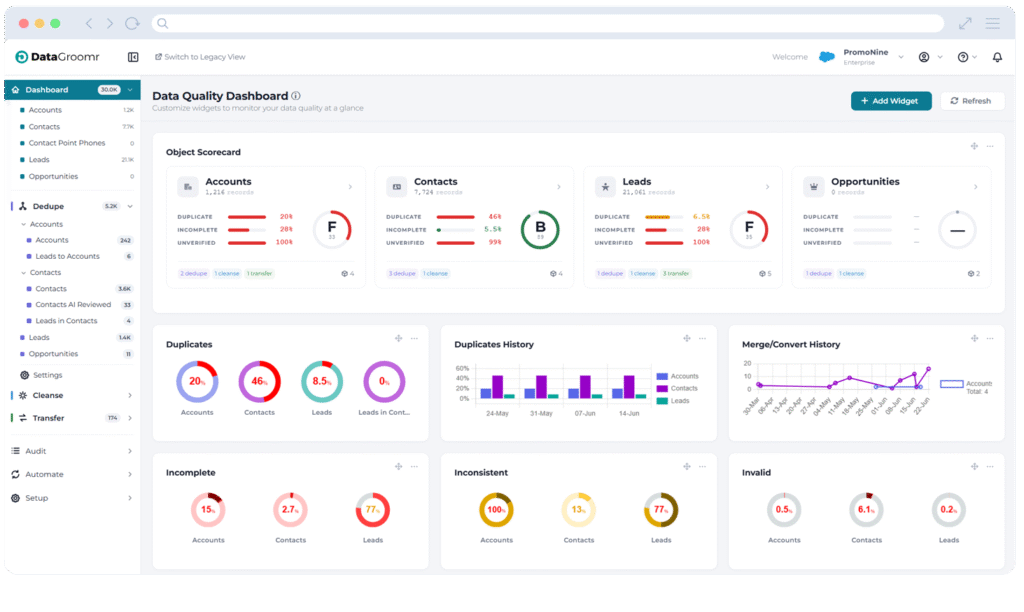
As organizations increasingly rely on AI, automation, and analytics, trusted CRM data has become a strategic business asset. Yet many organizations still struggle to answer fundamental questions about the health of their Salesforce data. Duplicate records, incomplete information, and invalid contact data often accumulate unnoticed until they begin impacting sales productivity, marketing performance, customer experiences, reporting, and AI outcomes.
DataGroomr’s new monitoring capabilities address this challenge by giving organizations continuous visibility into the quality of their Salesforce data. Rather than discovering problems only after they have affected business processes, administrators and operations teams can identify emerging trends, prioritize remediation efforts, and measure improvements over time.
The new capabilities include:
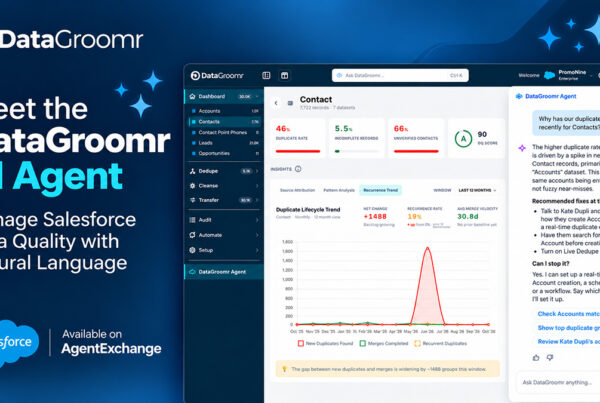
- Organization Health KPI – Monitor duplicate rate, incomplete records, unverified Contacts, and an overall Data Quality Score with trend indicators and configurable thresholds.
- Object Health Scorecards – Compare data quality across Salesforce objects to quickly identify areas requiring attention.
- Configurable Monitoring Dashboards – Build customized dashboards using Organization Health and Object Health widgets to monitor the metrics most important to your business.
- AI-Assisted Completeness Scoring – Leverage AI to recommend meaningful completeness fields based on object metadata and usage patterns, creating more accurate measurements of data quality.
- Cross-Object Data Quality Monitoring – Gain visibility into data quality trends across related Salesforce objects to better understand how data issues impact business processes.
These new monitoring capabilities expand DataGroomr’s AI-powered Salesforce data quality platform, which helps organizations monitor, deduplicate, standardize, verify, enrich, import, and automate trusted Salesforce data. Together, these capabilities help organizations maintain clean, complete, and reliable data that supports better business decisions and more effective AI, automation, and analytics.
“Organizations can’t improve what they can’t measure,” said Steve Pogrebivsky, CEO of DataGroomr.” As Salesforce becomes the foundation for AI, automation, and analytics, organizations need continuous visibility into the health of their CRM data. These new monitoring capabilities help customers identify issues earlier, measure progress over time, and make data quality an ongoing operational discipline rather than a periodic cleanup project.”
The new monitoring capabilities are available as part of the DataGroomr platform.
About DataGroomr
DataGroomr is the leading AI-powered Salesforce data quality solution. As the first data quality platform built entirely on AI, DataGroomr leverages advanced machine learning and GenAI to identify and merge duplicates, standardize formats, validate global contact information, and automate maintenance without complex setup or configuration.