Clean data isn’t a nice to have; it’s a must have. You know it, I know it, and all of our various AI agents know it. But having an issue and acting to fix it are two distinct mindsets. Any specific issue can take hours of research, configuration, and implementation to resolve. You might need to learn a cumbersome new tool, build rules, construct integrations, and navigate unfamiliar screens. During my years in the Salesforce ecosystem, I’ve noticed this consistent pattern: everyone agrees data quality is an issue, everyone can describe it, but the effort required to get there takes time we just don’t have – and aren’t ready or willing to invest (let’s be honest).
I thought AI was supposed to save us time. Thankfully, with DataGroomr, I was right!
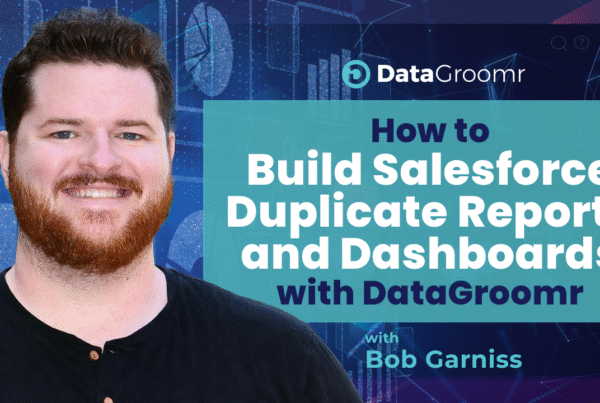
DataGroomr leans on AI and natural language to speed and simplify cleaning your data fast. In the following video, I cover four of my favorite ways DataGroomr and AI work hand-in-hand to save you time and get cleaning your data right away!
Why AI Matters for Salesforce Data Quality
Data quality work is repetitive, detail-heavy, and depends entirely on business context. Duplicate detection, merge decisions, field prioritization, and quality scoring require judgement calls that teams with deep understanding of your business must make day-in and day-out. . That means they spend time, better used to complete more critical tasks, manually building rules and reviewing exceptions one-by-one.
DataGroomr’s AI features replace that manual effort with intelligent automation. Instead of being challenged by a blank configuration screen, you lean on smart matching models, AI-driven recommendations, and natural-language prompts to achieve accurate first results fast. Then your teams can customize our tools further to align better with your organization’s processes and standards.
1. AI-Trained Matching Models for Finding Duplicates
Matching models are deduplication’s foundation stones. They determine how DataGroomr identifies records that are likely duplicates. The challenge is deciding which fields actually indicate a match, especially when names, addresses, phone numbers, and other identifying information are incomplete or inconsistent.
A classic matching model is anchored in traditional rule-based logic. A machine learning model, by comparison, learns from examples and patterns in the data but still needs to be trained first. That distinction matters with large, messy datasets, where a machine learning model tends to perform better than classic models.
An AI-driven model is superior to both. AI-driven tools, like DataGroomr’s AI Assistant, analyze all fields in your object and recommend which fields to consider in your model. Our AI Assistant then trains your model for you. As a result, you now can focus on other tasks that actually need your judgement.
2. Resolve Duplicate Records with AI Recommendations
Identifying potential duplicates only solves half the problem. Someone still has to decide what to do with them. That’s where Get AI Recommendations comes in.
Get AI Recommendations speeds that decision-making. It reviews duplicate groups and suggests next steps such as merge, unmatch, link, or split. Equally important, the suggested final version includes the rationale behind the recommendation so you can understand why the action was proposed before approving it. Thus, you maintain complete control while reducing the time spent investigating each group from scratch.
Once your recommendations are ready, a helpful tag is automatically applied to each matched group, allowing you to easily take mass action, or even automate resolution.
3. Create Master Record Rules in Plain English
Deciding which record survives as the master record can be a tough call. DataGroomr’s AI Recommendation template removes the guesswork by scanning the fields on your object and generating a rule that fits your actual data.
You can then simulate this new rule in the Rule Simulator. Need to make changes? Just describe what you want in natural language. The AI handles the rest.
4. AI-Generated Data Quality Models
Data quality models score your records against rules for completeness, consistency, and other quality indicators. These are powerful, but they are also tricky to define since every organization has different standards for what “complete” or “ready” actually means.
That’s where DataGroomr’s AI-powered templates come in. Templates like Incomplete Records, Junk Records, and Stale Records are tailored to your org automatically, scanning your object to discover the relevant fields on their own. What used to take hours of configuration becomes a starting point you can refine and test in minutes.
Need to make any changes? Just describe what you want in natural language. The AI handles the rest.
Check out the full video to see all four AI-powered features in action!
Final Thoughts
AI isn’t a panacea. It doesn’t completely eliminate the need for managing data quality, and it is only as good as the policies and procedures it builds upon. But AI, applied properly, can save you a lot of stress and time, freeing you to focus on more critical strategic work that demands your expertise.
You already know your data needs cleaning, otherwise you would not have read this entire blog post and watched the video (or skimmed to the bottom, I see you). Put AI to work for you, and “make clean data your superpower”.
To see these features in action, request a live demo or start a free trial at datagroomr.com. You can also learn more in the DataGroomr support documentation at help.datagroomr.com.