Artificial intelligence is transforming the way that organizations are leveraging Salesforce. Today, AI is at the heart of customer relationship management, from predictive analytics and automated processes to conversational assistants and automation powered by Agentforce. But as firms use generative AI technologies, many are learning that the key to AI success is data quality.
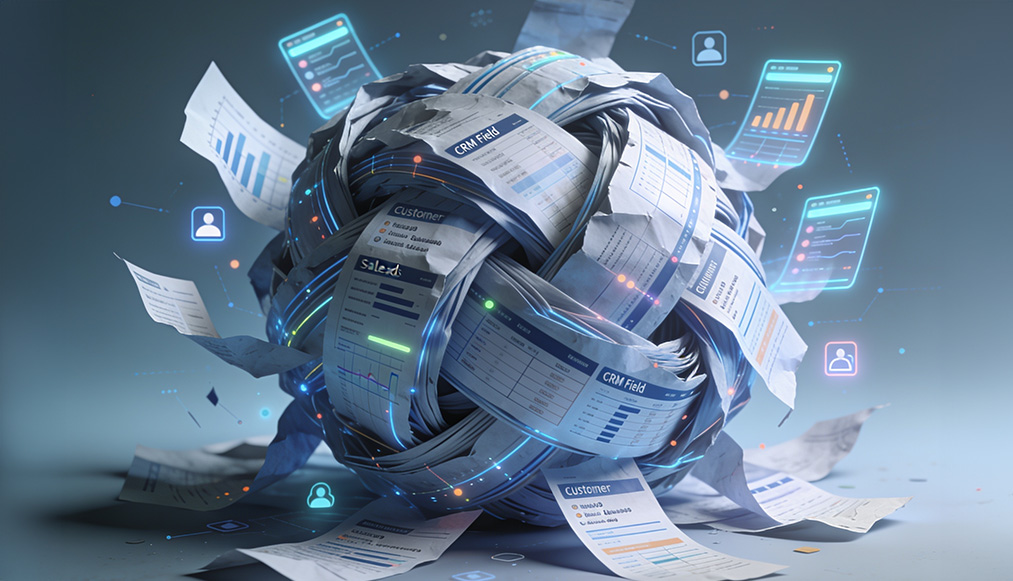
Duplicate records are one of the biggest data quality problems in Salesforce set-ups. Duplicate accounts, contacts, leads and opportunities are not just operationally inefficient, but they also are a direct cause of AI hallucinations, when AI systems make things up or give false or misleading information. Salesforce deduplication has become not just a routine CRM maintenance task but also an essential means to enhance the dependability and credibility of AI.
Salesforce AI “hallucinations” occur when large language models provide responses that seem genuine but are actually incorrect or not supported by reliable evidence. In Salesforce, hallucinations are widespread when AI algorithms are fed fragmented, outdated, conflicting or redundant data. A firm may have multiple versions of a single customer account, for example, each with a slightly different name and inconsistent contact data, service history or sales information. An AI assistant trying to summarize the customer relationship or build suggestions would combine contradicting information, miss key data, or link the wrong action with the wrong account. These issues are particularly troublesome for AI-based applications such as Einstein Copilot, Agentforce assistants, automated customer care systems, predictive lead scoring, and Retrieval-Augmented Generation (RAG) frameworks.
The Hallucination Problem with Duplicate Data
Duplicate content harms AI adoption by creating ambiguity and reducing the reliability of AI systems. Accurate contextual retrieval is a prerequisite for generative AI models to deliver accurate outputs. When duplicate records exist, the retrieval layer may access conflicting versions of the same customer, account, or transaction, leading to confusion in the AI’s context window.
For example, one customer record can indicate a consumer is active and another record marks them as inactive or churning. One opportunity record may contain the latest revenue figures while another might still reflect previous projections. Contradictions may lead AI systems to generate false summaries, inaccurate recommendations, or misleading insights. Instead of relying on one source of truth, the system attempts to reconcile competing versions of reality. This makes it more likely to hallucinate.
How Duplicate Data Impacts Customer Identity Resolution
Duplicate data also leads to fragmented consumer identification resolution. AI systems work best when they are fed consistent, unified client profiles. Duplicate records mean Salesforce doesn’t have a complete, single source of truth for each customer. This fragmentation makes it difficult to personalize, forecast, make sales suggestions and communicate with customers. AI-generated sales recommendations may be provided to the wrong individual, or fail to account for the customer’s entire purchase history if relevant data is stored in multiple duplicate records. Also, AI-generated summaries may provide customer care agents with incomplete or inconsistent information, leading to poor customer experiences.
Deduplication and RAG (Retrieval-Augmented Generation)
Data duplication can undermine the retrieval algorithms that power modern generative AI frameworks such as Retrieval-Augmented Generation (RAG). RAG systems improve AI reliability by including key enterprise data in prompts prior to generating responses. However, the effectiveness of RAG heavily relies on the quality of retrieved information. If the AI is pulling from a knowledge base with duplicate or conflicting data, it may pull duplicate documents, outdated records or conflicting client histories. This retrieval noise reduces the quality of AI-generated outputs and increases token usage, while reducing the overall quality of the answer. Cleaning up duplicate items and merging information sources goes a long way in boosting retrieval relevancy and lowering hallucinations for companies.
Risks in Autonomous AI Environments
As organizations deploy more autonomous AI agents and process automation in the Salesforce ecosystem, the risk of duplicating data increases. AI agents that can create or change records can mistakenly create duplicates at machine scale without proper governance and deduplication controls. This results in a feedback cycle where bad data quality further deteriorates AI performance. Executives at many firms are already beginning to recognize that AI is not solving current data quality challenges, but rather exacerbating them. In sum, AI systems will scale the data environment you supply them, whether it’s clean or chaotic.
The Benefits of Data Deduplication for AI Performance
Data deduplication provides a number of major benefits to companies seeking to enhance AI performance in Salesforce. More importantly, deduplication aids AI accuracy by providing cleaner, more reliable contextual information. Unified customer records enable AI systems to generate more accurate sales insights, customer summaries, service recommendations and forecasts.
Second, deduplication improves customer experiences by reducing repetitive outreach, duplicate support tickets, conflicting messages, and inaccurate personalization. Consumers are far more likely to trust companies that communicate regularly and keep reliable records in the course of interactions.
Deduplication also creates trust in AI systems across the organization. One of the biggest barriers to enterprise AI adoption is user confidence. If employees see AI hallucinations or wrong outputs repeatedly, faith in the system quickly diminishes. Clean, high-quality data helps ensure AI-generated recommendations are consistent, explainable and trustworthy. From a technical perspective, deduplication also improves AI efficiency. Removing duplicate records decreases the amount of storage needed, the complexity of retrieval, the size of the vector database and the number of tokens utilized. As a result, AI systems become more efficient, more scalable, and less expensive to operate.

How to Get Rid of Duplicates in Salesforce
There are multiple approaches for Salesforce companies to eliminate redundant data and improve AI reliability. Native duplicate management tools in Salesforce include limited matching and duplicate detection for leads, contacts, and accounts. However, these built-in features often struggle with large scale applications or complex fuzzy matching needs, which shows why Salesforce deduplication is not enough on its own. This is why many companies are supplementing their native solutions with AI-powered deduplication that employ machine learning and semantic matching to more consistently identify duplicate information. Salesforce Data Cloud also provides identity resolution to unify customer profiles across systems and channels, leading to cleaner data for AI use cases.
Tools are available, but successful de-duplication is more than a one-time cleanup activity. Organizations need ongoing data governance procedures, such as ongoing audits, automatic duplicate prevention, consistent data entry rules, stewardship routines, and periodic checks on AI quality. Without continuous governance, duplicate records can reappear. Companies may also establish a single source of truth for consumer data and enhance RAG knowledge repositories by removing out-of-date content, inconsistent records and duplicate papers before deploying AI assistants or autonomous agents.
The Future of AI and Data Quality
As Salesforce continues expanding its AI ecosystem, data quality will become even more strategically important. Future AI systems will need more and more real-time identity resolution, intelligent entity matching and autonomous data governance. Interestingly, AI itself is beginning to play a greater role in improving data quality through automated deduplication, better semantic analysis, and intelligent record matching. This creates a virtuous cycle where better data leads to greater AI performance and better AI systems lead to better data management.
At the end of the day, AI hallucinations in Salesforce aren’t caused solely by the limitations of language models. Often they are an indication of underlying data quality problems. Duplicate records fragment consumer identities, weaken retrieval systems, and introduce ambiguity into AI-generated outputs. This is why data deduplication is becoming essential for trustworthy enterprise AI. Organizations that prioritize clean, consistent, connected CRM data will not only reduce hallucinations, but also build AI systems that are more accurate, scalable, efficient and trusted across the enterprise.
FAQ
Duplicate records do not necessarily need to be carbon copies of one another. In fact, most duplicates are known as “fuzzy” duplicates, meaning they contain different versions of the same information. When AI systems encounter such “fuzzy” duplicates, they don’t know that these are duplicate records and try to reconcile the differences themselves. Needless to say, this can lead to a lot of issues such as inaccurate recommendations and forecasts.
RAG allows you to do more with your LLM model(s) by extending their capabilities to learn from your data and create chatbots and other AI tools to be used in your specific domain. Therefore, having clean data, which is free from duplicates and other issues, is important for both the training process and the end result produced by the model. With dirty data, you will just burn through tokens while having a lower-quality output.
Maintaining good data quality is an ongoing process. You need to be constantly vigilant of the data that comes in from sources, imports, customer forms, employee errors, and other sources. It is also worth noting that if you are using AI agents, you need to keep an eye on their activity if you are giving them the ability to create and modify records. Be sure to conduct regular audits and have rules in place to prevent duplicate records.