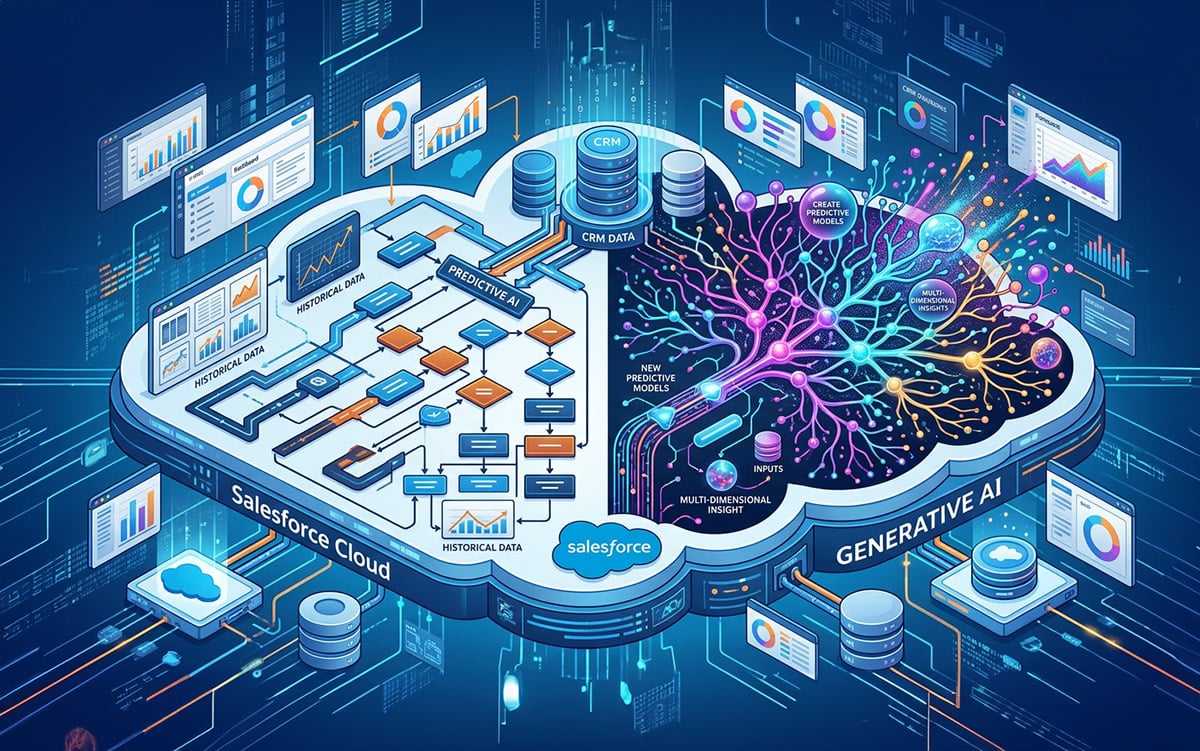
Salesforce is more than a CRM. It is a complete solution to assess consumer behavior, optimize workflows, and leverage data for decision-making for organizations. Some of its most effective tools, generative and predictive AI, are gaining more and more importance since they help improve the performance of the organization’s CRM in different ways. The content and responses are generative AI. Predictive AI is data analysis, which forecasts future outcomes. With the power of Salesforce technology, Einstein and Agentforce, Salesforce services the sales, marketing, and customer support workflows. Salesforce teams get more insight into their differences and discover the most relevant use cases. This boosts productivity, optimizing the use of their CRM investment.
What is Generative AI in Salesforce?
Generative AI involves employing large language models and other AI to produce content based on a mix of prompts, context and prior content. Service responses can be created, conversations with customers can be summarized, sales emails can be written, or data can be extracted from Salesforce CRM accounts. To Agentforce, this translates to the ability for companies to leverage their existing workflows and follow their existing rules and permissions to perform activities using AI agents and the company’s corporate data. With Salesforce Einstein, generative AI is integrated right into the CRM. Teams can create prompts that can be reused to produce the AI output from Salesforce data with Prompt Builder.
Gen AI is able to save you time from a sales standpoint writing prospecting emails, taking follow-up notes, or preparing for a meeting. After going through a recap of the highlights of a discovery chat, AI can write you an email that will resonate with the prospect and what comes next. It can also be used by the rep to check their history with the client and any outstanding items prior to a renewal call. Generative AI is helping customer support agents to summarize cases and draft responses. If you’ve set it up, Agentforce will do some of the work for you. An agent might elicit a response using approved knowledge. It can be a tool for marketing for campaign pieces and topic lines.
These tools will help ensure communications are more standard and effective, and save staff time from having to manage the more complex problems that can’t be handled by computers. That is to say, there is still a need to comprehensively check the authenticity of data and ensure consumer information is protected.
What is Predictive AI in Salesforce?
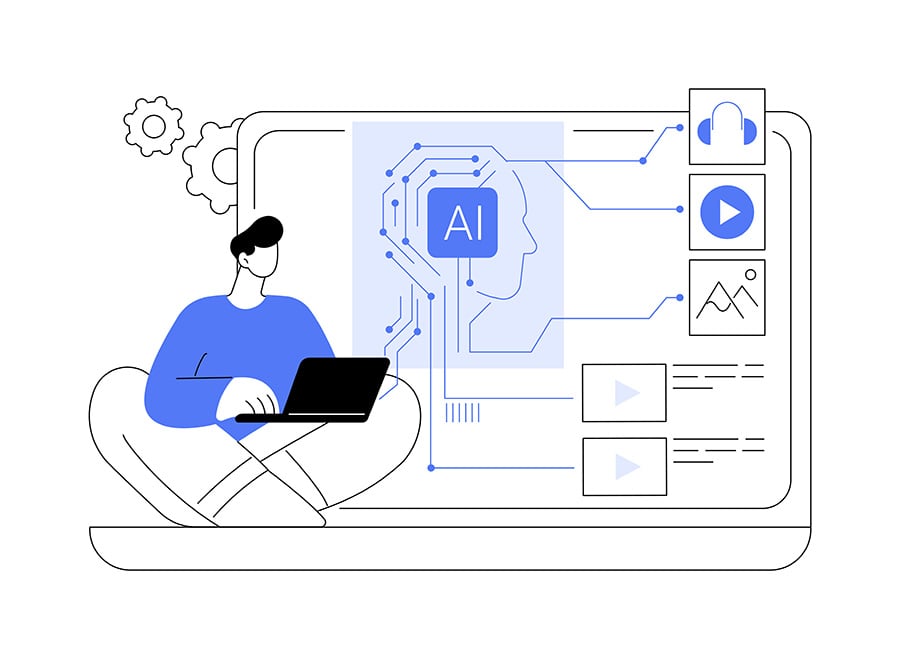
Predictive AI predicts future outcomes by using historical data, behavioral patterns, and machine learning algorithms. It’s not about creating content, it’s about helping Salesforce customers pick prospects, analyze opportunities, forecast revenues and identify potential customer risks.
Forums and CRM workflows that are supported by Salesforce Einstein receive predictive functionality natively, such as Einstein Lead Scoring, Einstein Opportunity Scoring and Einstein Forecasting. These, and many other Einstein and Agentforce capabilities, rely on the products, licenses and configurations an organization has; so it makes sense to establish what’s possible today prior to planning a deployment.
With Einstein Lead Scoring, sales teams can learn from what has worked in the past to prioritize leads by knowing which traits are common among those who have converted. It’s particularly beneficial for companies that receive a substantial volume of leads from web forms, promotions and events. Instead of treating all leads evenly, predictive ratings enable reps to prioritize their prospects to reach them sooner rather than later.
Einstein Opportunity Scoring helps sales organizations prioritize those opportunities that are most likely to close. Forecast revenue with Einstein Forecasting to gain insights into what could happen next with sales and a fresh perspective on future revenue. These capabilities can help pipeline managers spot pipeline risks and enable them to make informed decisions on where to invest resources.
In areas where client churn or disengagement data and models exist, AI can also be employed to improve client retention by recognizing behaviors that indicate potential churn or disengagement. But forecasts are only estimates and not certainty. The key to success is data quality, model performance and the ability to have patterns that reflect past models and the business realities of today.
Key differences between Generative AI and Predictive AI
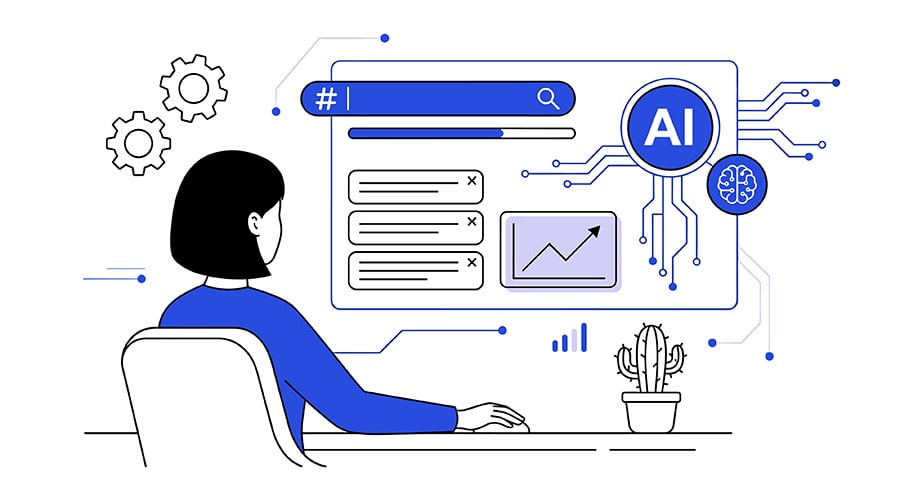
The main difference between predictive AI and generative AI is the type of output and the business objective. Generative artificial intelligence can create content such as emails, summaries and customer service responses. Predictive AI offers ratings, probabilities, forecasts and other estimates that help teams predict what will happen in the future.
For example, Einstein Lead Scoring helps a salesperson know which leads to pursue and then generative AI may enable targeted outreach based on what’s important to the prospect.” Predictive AI determines where a salesperson should spend their time and generative AI helps structure communications of interest to the prospect.
The technologies also differ in how performance is measured. The effectiveness of generative AI is a function of the accuracy of the material it generates, its relevance, the time it saves, and the extent to which users accept it. The predictive AI must be evaluated on the accuracy of its forecasts, conversion rates and the effectiveness of the judgments made on its output. Salesforce teams can use an understanding of these differences to select the right tools, and to set realistic expectations around what implementation can deliver.
Salesforce Generative AI and Predictive AI better together
The ability to deploy generative AI and predictive AI together in the same Salesforce workflow, will be the biggest value for many enterprises.Imagine a sales team that is drowning in leads. Einstein Lead Scoring identifies leads that are similar to those that have converted in the past. Then a rep pulls up the lead’s Salesforce record, and employs generative AI to compose a personalized outreach email with relevant client information.
The rep writes the email and clicks send. Then they follow participation in SF. The team can then track if this improves response rates, conversion rates, or the time it takes to engage qualified prospects.The same could be done to keep the clients. Predictive algorithms can help surface accounts that are showing signs of imminent churn, giving customer success teams the ability to dig deeper into the root causes. Then generative AI may help provide a summary of the account and suitable communication to the consumer. You can extend the pipeline to support other Agentforce actions.
This duality creates a practical division of labor: predictive AI assists teams in identifying where attention might be best placed, and generative AI helps produce relevant content and communication. They can also help to personalize the customer connection, with predictive AI identifying the right leads, and generative AI customizing communications based on their needs and interaction history. Employees should still read the key information and consider whether a proposed course of action is appropriate.
Salesforce AI: Best Practices for Implementation
The secret to successful AI is that it starts with a well defined business challenge. Teams have to show a workflow that would benefit from automation or some kind of predictive insight. An AI could assist a sales team with follow-up emails, or a revenue operations team could receive improved lead prioritization or more accurate forecasts, for example. If you understand what the performance was before AI was implemented, you will be better able to evaluate the results.
And the data has to be correct, too. Issues such as duplicate records, missing fields, old customer data, inconsistent opportunity phases, etc., can quickly derail predictive algorithms and content generation. Salesforce admins should establish rules for data management so that appropriate data is fed into AI workflows.
You need governance and security at the corporate level. Generative AI-compatible needs will need to have the trust and data security measures that Salesforce’s Einstein Trust Layer will give, but organizations need to evaluate their own permissions, vendor terms, compliance and overall setup. Customer data must be processed in accordance with the organization’s policies and legal requirements.
There is also the matter of oversight by humans, which still matters. This is the case when the AI’s output is sent to customers, or when predictions are used to make critical business decisions. Staff should check the results and pursue any unexpected ideas. Metrics should be put in place with a specified set of stated objectives including time saved, content quality, conversion rates, forecast accuracy and retention outcomes. By watching often you can see where changes need to be made as your company environment changes.
Measuring the impact of AI in Salesforce
AI adoption for Salesforce teams needs to be linked to operational efficiency, customer outcomes and business performance — not just consumption. But the activation of an AI function does not mean a higher success rate in sales or customer satisfaction. The results depend on having the right data, implementing it correctly, involving employees and providing adequate oversight.
Good KPIs for generative AI might be the percentage of drafts written that are accepted with minimal revisions, time spent writing emails and case summaries, and improvements in customer satisfaction or employee productivity. For example, predictive AI lets companies track conversion rates (leads to opportunities), opportunity win rates, prediction accuracy and the success of retention efforts.
Organizations should also establish a baseline and, where possible, compare findings to a control group or phased rollout prior to implementation. This allows to separate the effect of AI developments from the effect of seasonality, marketing campaigns or other company activities.
An additional important point is to separate model performance from business performance. If employees don’t act on right estimates they won’t generate additional revenue. Likewise, good AI content doesn’t always mean more client engagement. The goal is to see if AI helps people make better decisions, serve customers better and achieve measurable results.
Generative AI and Predictive AI Together in Salesforce Now
AI’s value in Salesforce isn’t as much about flipping a switch on features, but how teams use the features. The best-placed firms to make AI a reliable part of their CRM strategy are those that improve data quality, put safeguards in place, train their people and measure outcomes against clear business objectives. The goal is to create better decisions, more productive customer interactions that deliver real corporate value.