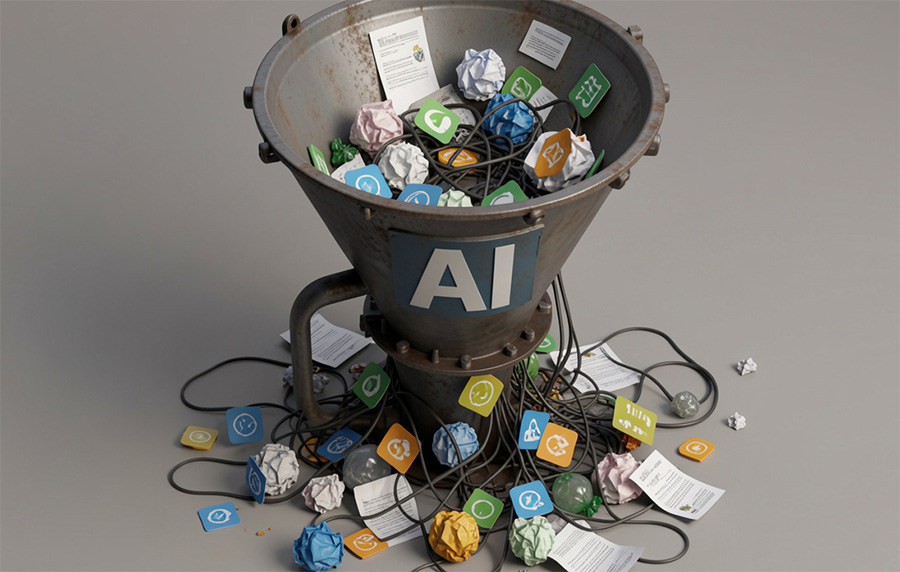
AI has quickly become a staple of every modern CRM strategy. Today, companies are leveraging AI inside Salesforce to automate customer care, gain sales insights, summarize cases, forecast opportunities, and personalize interactions at scale. But with the rush to generative AI accelerating, many businesses are coming up against an unpleasant reality: AI systems are only as good as the data they’re built on.
This is where the saying “garbage in, hallucinations out” comes in. AI systems cannot deliver reliable outputs when fed duplicate entries, incomplete customer histories, outdated data, inconsistent fields and poorly managed Salesforce workflows. In operational situations, these inaccuracies can be even more damaging when AI presents them in a polished, convincing way. AI can’t pick up on company irregularities or fill in business context the way people can. It relies on how good, how structured and how consistent the data it can access is.
Why Data Quality Matters for Salesforce in the Age of AI
For years, many firms have seen Salesforce as a digital filing cabinet, a repository for contacts, accounts, opportunities and support tickets. Data imperfections were commonly tolerated since a human user would hopefully notice and then fix inconsistencies by hand. Salespeople could see duplicate accounts, support teams could read between the lines of case notes, and supervisors could mentally fill in the spaces.
Generative AI Changes That
AI systems operate on probabilities. They find patterns, relationships and context solely from the information available within the CRM environment. If the underlying Salesforce data is fragmented or inconsistent, AI cannot distinguish authoritative data from poor-quality data. Instead, it attempts to generate the most statistically probable response, even if the underlying information is missing or inconsistent.
With firms using AI solutions like Einstein Copilot and automated workflow assistants, the need for clean CRM data is exponentially larger. AI systems don’t just scan Salesforce records; they use that data to decide, recommend and forecast.
Understanding Hallucinations in Salesforce AI
People think of hallucinations as AI thinking up totally fake replies. But hallucinations tend to be far more subtle in corporate environments. They look like reasonable proposals, summaries or conclusions, but they are built on inaccurate or incomplete data.
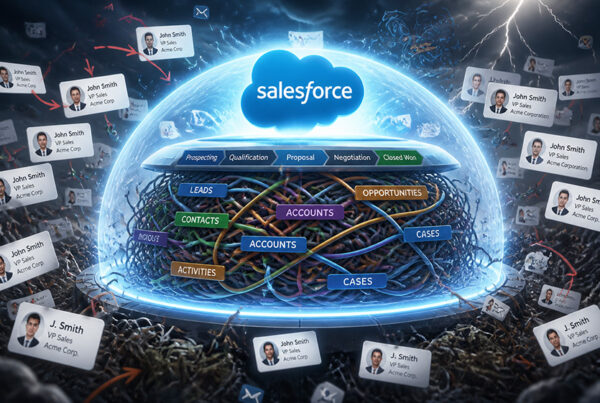
For instance, an AI assistant might offer the wrong product because consumer preferences are stored differently from account to account. Forgetting to log activities may cause a sales summary to lack important context. Duplicate records can fragment a customer’s history, resulting in an inaccurate case summary for support representatives.
This situation is especially detrimental because consumers naturally trust polished AI-generated content. Employees might act on AI’s partial truths without realizing the underlying data is inaccurate.
Often the AI model is not to blame for the delusion. This real issue is the organization’s inability to maintain accurate data structures in Salesforce.
The Hidden Issue of Dirty Customer Data
Many Salesforce environments grow over the years without strong governance. Each department designs its own processes, custom fields, workflows, and naming standards. The end result is bloated CRM systems with inconsistent picklists, missing data, duplicate fields and disconnected customer journeys.
Before AI deployment, this creates operational pain points. But once AI is adopted, it becomes a strategic liability.
AI systems only perform well with structured, connected and standardized data. AI models have trouble understanding right customer segmentation when one department calls consumers “SMB” and another “Small Business” while another leaves the field empty. Inconsistent sales stages or missing opportunity history data can degrade the accuracy of forecasts.
What’s especially dangerous here is that AI doesn’t always fail in an obvious way. Rather, it might offer responses that are basically true, but subtly wrong – giving users a false sense of confidence.
Retrieval-Augmented Generation is Raising the Bar
Retrieval-Augmented Generation (RAG) is becoming part of modern enterprise AI where organizational data is retrieved in real-time before generating a response. Salesforce has been a huge proponent of this design because it allows AI systems to provide output based on information that is specific to the organization, not merely training data from the public domain.
RAG improves personalization and relevance, but it’s also based on a critical dependency: the retrieval system must have access to trustworthy information.
If an AI draws on stale documentation, duplicate accounts, contradictory customer records, or incomplete customer histories, the result it generates is not reliable. This is how RAG increases the quality of the underlying ecosystem. Good data = good answers, in a well contextualized way. Bad data = confident illusion.
In other words, you can’t just “add AI” to a flawed CRM environment and expect positive things to happen. A strong data foundation is the critical foundation of AI development.
AI Governance’s Biggest Challenge Is Data Quality
Historically, data quality initiatives have been viewed as cumbersome administrative chores, not business priorities. That’s quickly changing. In the age of AI, data quality directly impacts operational trust, automation reliability, compliance, and customer experience.
Bad CRM data is now a measurable business risk. Inaccurate AI suggestions can lead to inaccurate predictions, poor customer interactions, compliance issues, and inefficient processes. If business leaders don’t trust the insights AI delivers, it may slow adoption of AI across the firm.
Therefore, enterprise platforms like Salesforce are increasingly investing in governance frameworks, trust layers, and secure AI architectures. But good governance mechanisms can’t make up for lousy underlying data. Organizations still need disciplined processes for data standardization, validation, clean up and lifecycle management.
In other words, governed bad data is still bad data.
Clean Salesforce Data as a Competitive Advantage
As firms quickly ramp up AI usage, clean CRM data becomes an even more important competitive differentiator. Strong control of Salesforce helps firms deploy AI systems more effectively since their data provides reliable context for automation, forecasting and decision-making.
These organizations gain better projections, better customer insights, better personalization and more dependable AI recommendations. Their AI outputs are more realistic, reflecting real business conditions, and their employees are more willing to use AI systems.
And at the same time, companies with fragmented Salesforce environments find it difficult to transition from AI demos into real-world production use. Their AI systems produce inconsistent results, employees lose faith, and automation doesn’t scale properly.
The difference between successful and failed AI adoption is increasingly coming down to one thing: data quality.
Improving AI Accuracy in Salesforce: How Enterprises Can Do It
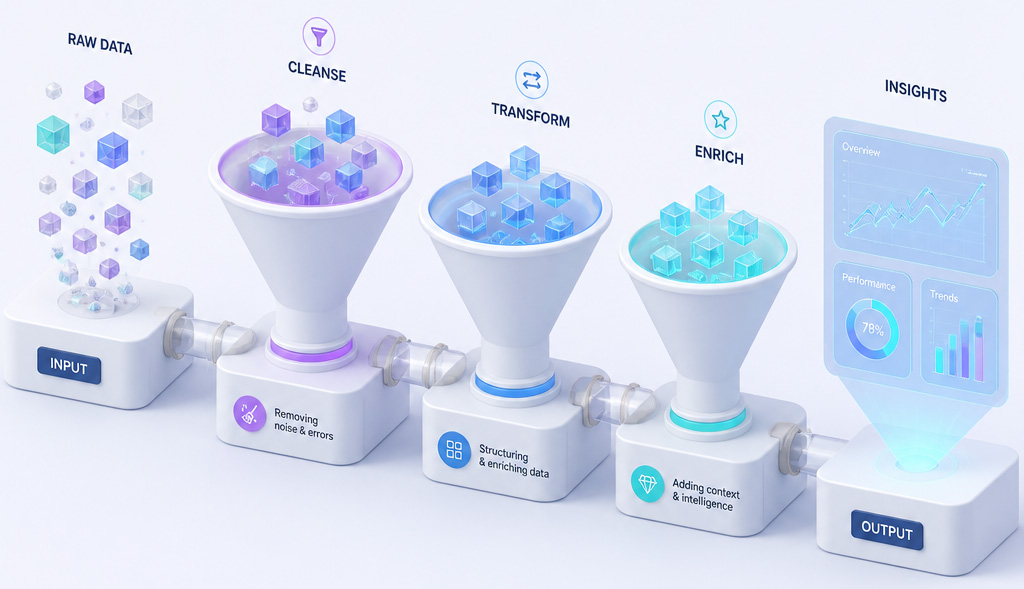
The step to improve AI accuracy is to improve CRM discipline. Organizations need to standardize data across departments so that fields, picklists, workflows, and customer classifications are standardized. They must also eliminate duplicate records, fix incomplete customer data, implement validation processes, and encourage more operational responsibility.
Governance is also crucial. Companies should establish clear ownership for data quality, integration standards, metadata management and lifecycle policies. AI systems should not pull data indiscriminately from every source, but be constrained to a finite set of reliable and validated sources.
Human oversight is also essential. AI should be an employee’s assistant, not a replacement for critical thinking and business judgement. Human review is still needed to identify mistakes, validate recommendations, and ensure decisions reflect actual business context.
Conclusion
The organizations that succeed with AI will not necessarily be the ones with the most advanced models. They will be with the organizations who have the cleanest, most reliable and most connected data ecosystems.
Two firms with varying quality CRMs and the exact same Salesforce AI solutions can observe radically different results. One organization gains trusted automation, precise insights and operational effectiveness. The other faces hallucinations, broken workflows and lost user trust.
AI is not the problem. The difference is data.
As enterprises double down on AI-powered Salesforce experiences, one fact is becoming harder to ignore: you can’t address organizational turmoil with technology. It can only speed it up.
FAQ
The AI tools within Salesforce rely on the data you have inside Salesforce. What this means is that all of the data quality issues you have, such as duplicate data, outdated customer information, etc., will be used to generate insights, which will not be of the highest quality. For best results, it is recommended to have high-quality data to get the most value out of your AI tools.
Hallucinations occur when AI produces believable yet false results. This can take the form of providing incorrect recommendations, inaccurate forecasts and many other things. The root cause of such hallucinations is usually incorrect or dirty data.
It all starts with data quality. If you keep your data free from the types of issues mentioned in the article above, you will see improved performance in AI quality. Keep in mind that this needs to be an ongoing process. Duplicates and other issues creep into Salesforce, and you need to stay on top of your data hygiene–not just to improve AI performance but also to maintain a well-governed CRM.