See DataGroomr in Action
AI-Powered Salesforce Lead Routing and Case Assignment
Route leads, cases and any record to the right rep or queue, even when the data is incomplete.
BOOK A DEMO

Route smarter with AI, not more rules.
Effective Salesforce lead routing is about matching the right work to the right person. DataGroomr uses AI to interpret records, fill in missing information, and find the best-fit person or queue based on your business criteria. From sales leads to customer support cases, automate intelligent assignments without building increasingly complex routing rules.
What is Salesforce lead routing?
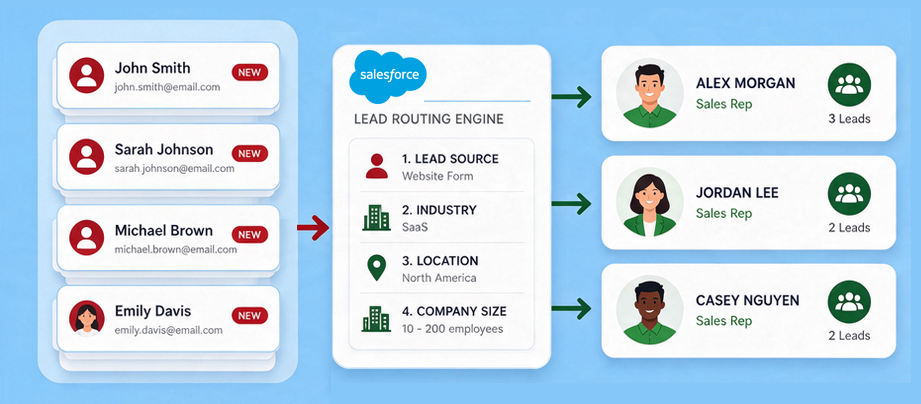
Salesforce lead routing is the process of automatically assigning incoming leads to the right sales reps or teams based on criteria such as territory, industry, company size, or workload. Salesforce calls its native rules-based approach lead assignment rules. AI-powered routing goes further by enriching incomplete records and matching leads to the best-fit owner.
Why Salesforce lead assignment rules fall short
Salesforce lead assignment rules depend on predefined criteria and the information available in each record. But incoming leads often lack essential company details, while customer support cases arrive with unstructured descriptions that don’t fit neatly into predefined categories.
Native Salesforce assignment rules have additional limitations. Only one lead assignment rule and one case assignment rule can be active at a time. Round-robin distribution requires additional configuration, and lead-to-account matching isn’t built into standard assignment rules. Rules also don’t automatically re-evaluate records as missing information is enriched; reassignment must be triggered through an appropriate Salesforce process.


When lead routing relies on incomplete or inconsistent information:
- High-value sales leads may land in generic queues.
- Customer cases may be assigned to teams without the right expertise.
- Missing data makes accurate territory, segment, or priority assignments difficult.
- Manual research and reassignment delay follow-up and resolution.
- Complex lead assignment rules require ongoing maintenance.
The problem isn’t always your lead routing logic. It’s the information your routing decisions depend on.
AI lead routing software for Salesforce
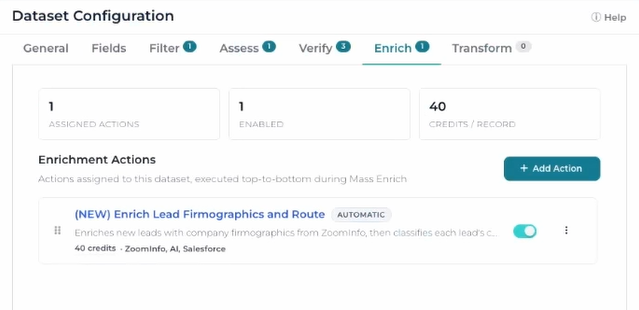
Intelligent lead routing shouldn’t require multiple tools and complicated workflows. DataGroomr combines AI-powered enrichment, classification, and lead assignment in one coordinated workflow. Describe your lead routing requirements in natural language and let DataGroomr handle the process.
- Understand and enrich records
Analyze existing Salesforce data, interpret free-text descriptions, and fill in missing information using AI and connected data providers. - Classify and prioritize
Determine a lead’s sales segment or territory, identify a case’s issue type or urgency, or apply other business-specific criteria. - Find the best-fit person or queue
Use natural language instructions to search Salesforce for the sales rep, support specialist, or queue that best matches each record’s requirements. - Automate assignment
Update record ownership in Salesforce based on your routing criteria, without relying exclusively on complex predefined assignment rules. - Work with your existing Salesforce setup
DataGroomr complements Salesforce lead and case assignment rules, Flow, queues, and Omni-Channel. Use AI to enrich and classify records so Flow, Omni-Channel, or assignment rules can route on complete data.
How AI-powered Salesforce routing works
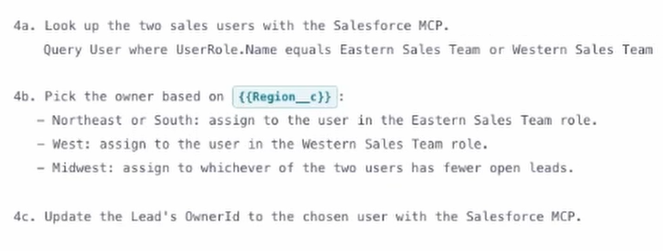
DataGroomr combines AI enrichment, classification, and lead assignment in one workflow. Here’s how it can turn an incomplete Salesforce Lead into a properly assigned sales opportunity.
Define routing instructions in plain English
For example:
“Enrich each new lead with company size, industry, and location. Classify the lead as SMB, Mid-Market, or Enterprise. Find the sales rep responsible for that segment and region, and assign the lead to that person. If the required information is unavailable, leave the owner unchanged for review.“
Salesforce lead and case routing criteria
Effective Salesforce routing goes beyond basic assignment rules. DataGroomr uses AI-powered enrichment, classification, and natural language instructions to match Leads, Cases, and other records to the right people or queues based on your business criteria.
Territory and geography
Enrich missing location data and classify records by region, country, state, or sales territory to identify the appropriate owner.
Segment and company size
Enrich company information such as employee count and annual revenue to route SMB, mid-market, and enterprise leads to the right sales teams.
Industry
Identify or standardize a company’s industry using AI and connected data providers, then assign leads to industry specialists.
Product interest
Use AI to interpret form responses, lead descriptions, or other available information to identify product interest and route prospects to the appropriate team.
Account ownership and lead-to-account matching
Use AI to search Salesforce for an existing Account associated with an incoming Lead, then consider the Account’s ownership when determining the appropriate sales rep. This helps route leads based on existing customer relationships rather than territory or company size alone.
Workload-based lead assignment
Distribute leads based on current rep workloads, such as assigning each new lead to the eligible sales rep with the fewest open leads. Unlike strict round-robin lead assignment, this approach considers existing workloads rather than following a fixed rotation.
Skills-based case routing
Classify customer issues from Case descriptions and match them to support specialists or queues based on relevant expertise.
Priority-based routing
Use AI to classify urgency, customer tier, or other priority indicators so high-priority Leads and Cases reach the appropriate teams faster.
Route Salesforce leads, cases, and custom objects
Route Salesforce leads to the right sales reps
Automatically enrich incoming leads with company details, classify them by segment or territory, and match them to the appropriate sales rep. Give your sales team better information and reduce delays caused by manual lead assignment.
Route Salesforce cases to the right support teams
Use AI to interpret customer requests, identify the issue type and priority, and find the support specialist or queue best equipped to help. Reduce manual triage and get customer issues to the right team faster.
Route other Salesforce records based on your criteria
Extend intelligent routing to other supported Salesforce objects and workflows. Use natural language instructions to define how records should be classified and matched to the appropriate owner.
Example: AI-powered Salesforce Case assignment
A customer submits a Case describing an unexpected charge on their account. DataGroomr analyzes the free-text description, classifies the issue as a billing dispute, and searches Salesforce for the appropriate billing specialist or support queue.
The Case can then be assigned automatically, without requiring the customer to select the correct issue category or an administrator to maintain extensive keyword-matching rules.
Salesforce assignment rules vs. Flow vs. AI-powered routing
Salesforce offers several ways to automate lead and case assignment. Traditional assignment rules work well for straightforward criteria, while Salesforce Flow supports more customized logic. DataGroomr adds AI-powered enrichment, classification, and natural language instructions to help teams make more informed routing decisions.
| Capability | Salesforce Assignment Rules | Salesforce Flow | DataGroomr |
|---|---|---|---|
| Lead distribution and workload balancing | Round robin possible with custom fields and formulas | Custom logic can support round robin and weighted distribution | AI-powered workload-based assignment, such as selecting the rep with the fewest open leads; strict round robin requires additional Salesforce configuration |
| Lead-to-account matching for routing | Not built in | Possible with custom matching logic | AI agent can query Salesforce to find a relevant Account and use its ownership information to guide assignment |
| Handling missing data | Relies on existing field values | Requires additional enrichment integrations or automation | AI-powered enrichment fills missing information before assignment |
| Reading free-text Case descriptions | No native AI interpretation | Possible with Salesforce AI capabilities and additional configuration | AI interprets descriptions, classifies issues, and identifies appropriate owners |
| Plain-English setup | No; configure rule conditions | Primarily visual workflow configuration; AI assistance may be available | Describe enrichment, classification, and routing requirements in natural language |
| Maintenance effort | Rules require updates as criteria change | Custom flows and integrations require ongoing maintenance | Natural language instructions simplify changes, although workflows still require monitoring |
Benefits of automated lead routing
Accelerate response times
Reduce delays between record creation and assignment, whether it’s a new sales lead or a customer support request.
Reduce delays between record creation and assignment, whether it’s a new sales lead or a customer support request.
Improve assignment accuracy
Match records to the right people or queues using enriched data, AI classification, and your business criteria.
Reduce manual work
Spend less time researching incomplete records, maintaining complex routing rules, and correcting assignments.
Adapt as your business changes
Update routing instructions as territories, support teams, responsibilities, and business priorities evolve.
Improve the customer experience
Help customers and prospects reach the right person sooner, with fewer handoffs and more relevant follow-up.
Built for SalesOps, ServiceOps, RevOps, and Salesforce Admins
DataGroomr helps sales, service, and operations teams automate record assignment, reduce manual work, and connect leads and customer cases with the right people faster.
- Sales Operations – Automate lead qualification, territory assignment, and sales rep matching.
- Service Operations – Classify incoming cases and route customer issues to the right support teams.
- Revenue Operations – Improve assignment consistency across Salesforce and reduce manual processes.
- Salesforce Admins – Simplify routing automation using natural language instructions instead of increasingly complex rules.
- Sales and Support Leadership – Help teams respond faster and focus on the customers and prospects they’re best equipped to serve.

Intelligent lead routing is part of a unified AI-powered data quality platform
DataGroomr combines AI-driven enrichment, deduplication, standardization, and automation to help organizations maintain accurate Salesforce data and streamline revenue operations.
Related Use Cases
Route Salesforce leads and cases intelligently with AI
From sales leads to customer support cases, DataGroomr uses AI to understand, classify, and route Salesforce records automatically — helping your teams respond faster and work more efficiently.
Route Salesforce leads intelligently with AI
Salesforce lead routing FAQs
How does AI-powered Salesforce lead routing work?
AI-powered lead routing uses company information, qualification criteria, and business rules to determine the appropriate sales rep or team. DataGroomr can enrich missing lead information, classify leads by segment or territory, and automatically match them to the right Salesforce owner.
Can AI automatically classify and route Salesforce cases?
Yes. DataGroomr can use AI to interpret case descriptions, classify customer issues, and identify the appropriate support specialist or queue based on natural language instructions. It can then update case ownership in Salesforce.
Can DataGroomr route records without Salesforce assignment rules?
Yes. DataGroomr can use natural language instructions to classify records, search for matching people or queues, and update Salesforce ownership. You can also continue using existing Salesforce assignment rules where appropriate.
What Salesforce records can DataGroomr route?
DataGroomr can support intelligent routing for Leads, Cases, and other supported Salesforce objects. Routing instructions can consider record attributes, enriched information, classification results, and your organization’s assignment criteria.
What are the limitations of Salesforce lead assignment rules?
Salesforce allows only one active lead assignment rule at a time. Standard assignment rules don’t provide built-in round-robin distribution or lead-to-account matching, and they don’t automatically re-evaluate records when new information becomes available. DataGroomr helps overcome these limitations by enriching missing data, classifying leads, and automating assignment based on your business criteria.
Can DataGroomr support round-robin lead assignment?
DataGroomr supports workload-based lead assignment, such as routing new leads to the sales rep with the fewest open leads. Strict round-robin or weighted distribution requires additional Salesforce configuration to track previous assignments or allocation shares. Because records may be processed in parallel, these approaches require safeguards to maintain the intended distribution.
Does DataGroomr support lead-to-account matching?
Yes. DataGroomr supports cross-object Lead-to-Account matching for deduplication and lead conversion. For lead routing, its AI agent can search Salesforce for an associated Account and use account ownership information to help determine the appropriate sales rep. This routing approach is configured through natural language instructions rather than a dedicated Lead-to-Account assignment feature.
How do you route Salesforce leads with missing company information?
DataGroomr uses AI-powered enrichment and connected data providers to fill in missing information such as industry, company size, revenue, and location. It then classifies leads according to your criteria and identifies the appropriate sales rep or queue. This enables automated lead routing without requiring prospects to complete lengthy forms.