AI presents new challenges to data security, privacy, and governance. DataGroomr’s commitment to keeping your data private and secure extends to our AI capabilities.
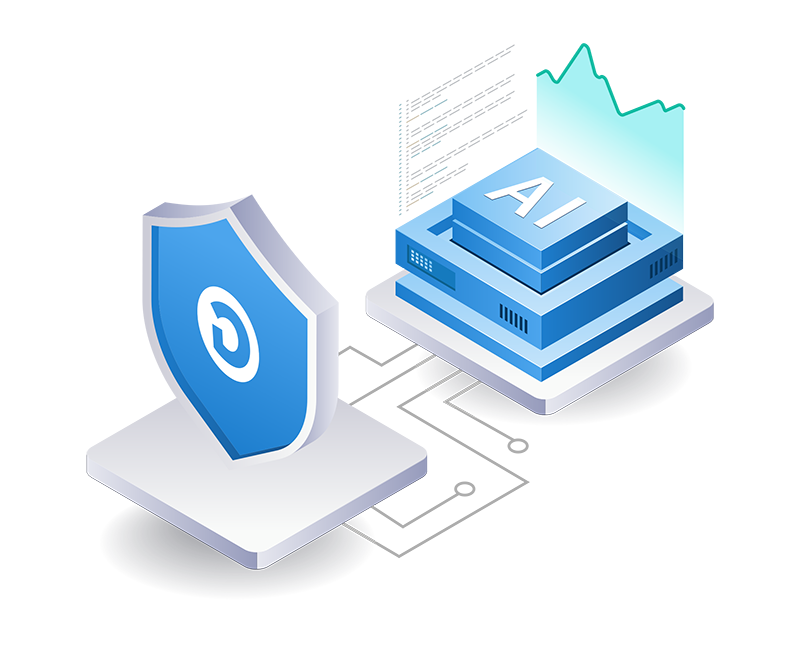
Your data is not used to train DataGroomr’s AI models, and DataGroomr’s Zero Data Retention policy ensures your data is never stored or used by our LLM providers to train their services.
Keep Control of Your Data
DataGroomr adheres to a Zero Data Retention policy. We do not store your customer data nor do we use it to train our AI models. Our data policies and controls also restrict LLM providers from using your inputs or outputs for model training.
Enforce Your Usage Policies
DataGroomr AI respects your user permissions and access controls.
Manage AI Features
Datagroomr’s AI features can be turned on or off with a single setting.
Keep Control of Your Data
Data security, data privacy and regulatory compliance are among Datagroomr’s highest priorities, especially for our AI-based features.
The LLM providers we use must have Zero Data Retention policies and they may not use your inputs and outputs to improve their services. Moreover, our data policies and controls restrict LLM providers from storing or training models using your inputs or outputs. In addition, we also limit the use and access of your customer data within our platform. Datagroomr’s AI capabilities can only access and act on information that you, as the user, already have permission to see or modify.


Enforce Your Usage Policies
Datagroomr’s AI functionality is designed to work within your current data usage policies. Your policies always take precedence.
When automation rules call AI-based functions, the AI functionality’s access to knowledge is determined by the permissions of that user in the DataGroomr application. Just as with all other functions in the Datagroomr platform, AI-based functions may retrieve information that only this user is permitted to access. Users will not be able to create or generate content based on resources they do not have access to.
Manage AI Features
Many companies are still grappling with how and when to integrate AI in their business processes. Some use cases, such as for internal systems, may be fine. But others that require more careful handling and extensive security, such as systems that handle customer data, may require more consideration before AI is allowed into the process.
Datagroomr is sensitive to these customer concerns. Customers who want to use our AI features have them at their fingertips. But those who do not can disable them by changing a single setting.

Privacy policy
DataGroomr’s privacy policy covers our treatment of data gathered
when you are accessing or using DataGroomr.com or the DataGroomr app.
FAQs
How does Datagroomr AI work?
DataGroomr AI runs on a combination of self-hosted models and third-party hosted models to deliver an artificial intelligence experience tailored to you, your teams, and your workflows.
These LLM providers will not store customer inputs and outputs or use this data to train their services. This approach prioritizes the privacy of your data throughout the entire process.
How should I use these features?
The models used in our AI-powered features generate responses based on your inputs and are probabilistic in nature. This means that their responses are generated by predicting the most probable next word or text based on the data that they have been trained on.
How does DataGroomr AI use customer data?
Datagroomr AI processes your user’s inputs to provide the outputs your user has requested. We may also process organizational data from within your site that the user has permission to view and include that data with the user inputs so that LLMs can provide more accurate, relevant, and contextual responses.
The LLM providers we use do not use your inputs and outputs to improve their services. In addition to the restrictive policies we have put in place for our LLM providers, we also limit the use and access of your customer data within our platform. DataGroomr may use metadata to fine-tune internal models that operate strictly within DataGroomr’s infrastructure, solely to improve the quality of responses and experiences we deliver to customers. This use of contributed data is subject to data contribution settings, and we apply robust safeguards, including de-identifying and aggregating all contributed metadata before use.
How is DataGroomr AI controlled?
Datagroom’s AI-based functionality is designed with security and privacy in mind: it can only access and act on information that you, as the user, already have permission to see or modify.
To protect sensitive data and ensure agents respect your organization’s security boundaries, your existing access controls govern all actions available to DataGroomr AI.
Please note, when automation rules call AI-based functions, the AI functionality’s access to knowledge is determined by the permissions of the ‘connecting’ user specified in the DataGroomr application, meaning AI-based functions may retrieve information that this user is permitted to access.
Which third-party LLMs are being used?
We use a diverse range of LLMs, including hosted LLM models from OpenAI’s GPT series of models, Anthropic’s Claude series of models, and Google’s Gemini series of models, to deliver the best outcomes for customers. Our features use dynamic routing to select the appropriate mix of models that can deliver the best experience and accuracy for each scenario.
The LLM providers we use do not retain your inputs and outputs, or use them to improve their services.
Do any of the LLM Providers store customer data?
No, none of our LLM providers store the data you submit or the responses you receive.
Does DataGroomr send customer data to any LLM platform to train its services?
The data you submit and the responses you receive from DataGroomr’s AI are not shared with third-party-hosted LLM providers for them to use to train or improve their services. Each data request is sent to the external provider individually over an SSL-encrypted service to process and send back to DataGroomr.
Can I limit which LLM providers are being used?
By default, DataGroomr leverages Anthropic models hosted on AWS Bedrock.
Eligible customers can elect to use their own LLMs and restrict LLM usage to those. This functionality is available to Enterprise subscribers.
Can I turn off AI features if my organization is not ready to use them?
Yes. Organization admins can activate or deactivate AI-powered features for their DataGroomr subscription..
You can learn more about managing DataGroomr’s AI features in our documentation.
Can I limit or restrict the data that is shared on DataGroomr?
We currently only offer opt-out controls for AI features at the app level.
As a reminder, DataGroomr’s AI-based functionality is always available and always on, as it is a core part of the DataGroomr platform. You can learn more about the available opt-out controls in our documentation.
Are you using my inputs and outputs to train Datagroomr apps and services?
DataGroomr does not share customer metadata or in-app data with our third-party-hosted LLM providers for them to use to train or improve their services. Our third-party hosted LLM partners, operate under strict zero data retention (ZDR) agreements.
DataGroomr may use metadata to fine-tune models that operate strictly within our infrastructure, solely to improve the quality of responses and experiences we deliver to customers. This use of contributed data is subject to data contribution settings, and we apply robust safeguards, including de-identifying and aggregating all contributed metadata before use.
Is DataGroomr’s AI SOC 2 compliant?
Yes, DataGroomr has completed the external assessment and compliance certifications for SOC 2. Moving forward, DataGroomr’s AI capabilities will be included as part of DataGroomr’s annual compliance audit.
Can DataGroomr’s AI be used in a HIPAA-compliant manner?
Yes, DataGroomr’s AI-based functionality can be used in a HIPAA-compliant manner within certain boundaries.
Does DataGroomr AI respect existing permissions?
DataGroom AI honors all existing permissions within each feature. Users will not be able to create or generate content based on resources they do not have access to.
Which users within my organization can access my data in DataGroomr AI if we enable these features?
DataGroomr respects all of your existing permissions.